Cluster B Personality Disorders – Types, Traits, and What to Know
Cluster b personality disorders are among the most widely searched — and most misunderstood — mental health topics. If you have noticed intense emotional patterns, impulsive reactions, or turbulent relationships in yourself or someone close to you, you are not alone. These patterns may point toward one of the four cluster b personality disorders recognized in the DSM-5. This guide breaks down each type, explains the shared traits, explores possible causes, and outlines what treatment can look like. You will also find a practical self-reflection checklist and a clear FAQ section. Whether you are here to explore psychology assessments or simply to learn, this article is built to give you honest, science-backed clarity — not labels.
What Are Cluster B Personality Disorders and Why Do They Matter?
Cluster b personality disorders are a group of four mental health conditions defined by the Diagnostic and Statistical Manual of Mental Disorders, Fifth Edition (DSM-5). They share a common thread: dramatic, overly emotional, or unpredictable patterns of thinking and behavior.
These disorders matter because they affect how people relate to others, regulate emotions, and perceive themselves. Unlike a temporary mood shift, cluster b patterns tend to be long-standing and deeply ingrained. They often begin in adolescence or early adulthood and can influence nearly every area of daily life — from work to friendships to romantic relationships.
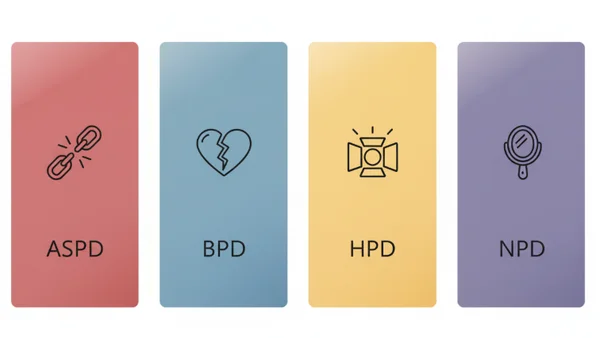
The four disorders grouped under Cluster B are:
- Antisocial Personality Disorder (ASPD)
- Borderline Personality Disorder (BPD)
- Histrionic Personality Disorder (HPD)
- Narcissistic Personality Disorder (NPD)
Each disorder has distinct features, yet they share overlapping traits like emotional intensity and difficulty maintaining stable relationships. Understanding the cluster as a whole can help you see the bigger picture before exploring each type individually.
Important: The information in this article is for educational purposes only. It does not replace a professional clinical evaluation. If you recognize concerning patterns, consider speaking with a licensed mental health provider.
What Are the Four Types of Cluster B Personality Disorders?
Antisocial Personality Disorder (ASPD)
Antisocial personality disorder involves a persistent pattern of disregarding — and often violating — the rights of others. People with ASPD may frequently deceive, manipulate, or act impulsively without remorse. Common signs include repeated legal conflicts, aggression, and a struggle to maintain responsibilities at work or home.
ASPD is sometimes confused with general "antisocial" behavior, but the clinical definition is far more specific. It requires a documented pattern that typically starts before age 15 and continues into adulthood.
Borderline Personality Disorder (BPD)
Borderline personality disorder is marked by intense emotional instability, a deep fear of abandonment, and rapidly shifting self-image. People with BPD may swing between idealizing and devaluing relationships. Impulsive behaviors — such as reckless spending, substance use, or self-harm — are also common.
BPD is one of the most researched cluster b disorders, and effective therapies like Dialectical Behavior Therapy (DBT) have shown strong results.
Histrionic Personality Disorder (HPD)
Histrionic personality disorder centers on an excessive need for attention and dramatic emotional expression. People with HPD may feel uncomfortable when they are not the center of attention. They often use physical appearance or theatrical speech to draw notice. Emotions can shift rapidly and may appear shallow to others.
Narcissistic Personality Disorder (NPD)
Narcissistic personality disorder involves a grandiose sense of self-importance, a strong need for admiration, and limited empathy. People with NPD may exaggerate achievements, expect special treatment, and react poorly to criticism. Beneath the surface, however, there is often fragile self-esteem that depends on external validation.
What Shared Traits Define B Cluster Personality Disorder Patterns?
Although each disorder has unique features, cluster b personality disorders share several core traits. Recognizing these shared patterns can help you understand the broader category before narrowing down specifics.
Common characteristics across all four types include:
- Emotional intensity — Reactions often feel disproportionate to the situation.
- Impulsivity — Acting on urges without considering consequences.
- Unstable relationships — Patterns of conflict, rapid attachment, or sudden withdrawal.
- Distorted self-perception — Either inflated or painfully low self-image.
- Difficulty with empathy — Struggling to consistently consider others' perspectives.
- Dramatic or erratic behavior — Actions that others perceive as unpredictable.
These traits exist on a spectrum. Having one or two traits does not mean you have a personality disorder. Clinical diagnosis requires a pervasive, long-term pattern that significantly impairs functioning.
How Do Cluster B Disorders Compare to Cluster A and Cluster C?
The DSM-5 organizes personality disorders into three clusters. Understanding the differences helps put cluster b personality disorders in context.
| Feature | Cluster A | Cluster B | Cluster C |
|---|---|---|---|
| Core Pattern | Odd, eccentric | Dramatic, emotional | Anxious, fearful |
| Disorders | Paranoid, Schizoid, Schizotypal | Antisocial, Borderline, Histrionic, Narcissistic | Avoidant, Dependent, Obsessive-Compulsive |
| Relationship Style | Withdrawn, suspicious | Intense, turbulent | Clingy, avoidant |
| Emotional Tone | Flat or detached | Highly reactive | Chronically anxious |
Cluster A disorders tend to involve social withdrawal and unusual thinking. Cluster C disorders revolve around fear and excessive caution. Cluster B disorders sit in the middle — defined by emotional volatility and dramatic interpersonal patterns.
Some individuals may show traits from more than one cluster. A comprehensive professional evaluation is the best way to understand which patterns apply.
What Causes Cluster B Personality Disorders?
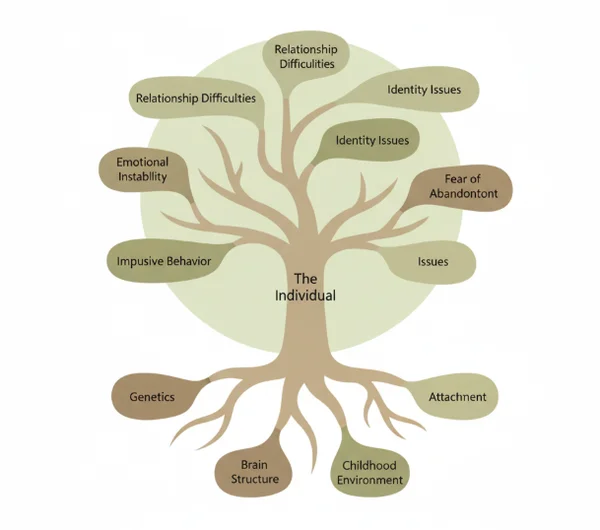
No single factor causes cluster b personality disorders. Research points to a combination of influences that interact over time.
Key contributing factors include:
- Genetics — Family history of personality disorders or other mental health conditions increases risk.
- Brain chemistry and structure — Differences in areas of the brain that regulate emotion and impulse control may play a role.
- Childhood environment — Adverse childhood experiences (ACEs) such as abuse, neglect, or household instability are strongly associated with these disorders.
- Attachment disruptions — Inconsistent or harmful caregiving during early development can shape long-term relational and emotional patterns.
It is worth noting that having risk factors does not guarantee a diagnosis. Many people with difficult childhoods never develop a personality disorder, and some individuals with cluster b disorders had relatively stable upbringings.
What Treatment Options Help With Cluster B Personality Disorders?
Treatment for cluster b personality disorders typically involves psychotherapy as the primary approach, sometimes supported by medication for specific symptoms.
Evidence-Based Therapy Approaches
- Dialectical Behavior Therapy (DBT) — Originally developed for BPD, DBT teaches mindfulness, emotion regulation, distress tolerance, and interpersonal effectiveness. It is one of the most validated treatments for cluster b conditions.
- Cognitive Behavioral Therapy (CBT) — Helps individuals identify and reshape unhelpful thought patterns and behaviors.
- Mentalization-Based Treatment (MBT) — Focuses on improving the ability to understand one's own and others' mental states.
- Schema Therapy — Addresses deep-rooted emotional patterns (schemas) that drive maladaptive behaviors.
When Medication May Help
No medications are specifically approved for personality disorders. However, doctors may prescribe:
- Mood stabilizers for emotional swings
- Antidepressants for co-occurring depression or anxiety
- Antipsychotics at low doses for severe impulsivity or distorted thinking
Treatment works best when it is consistent and long-term. Progress may feel slow at times, but many people experience meaningful improvements in relationships, self-regulation, and quality of life.
A Self-Reflection Checklist for Recognizing Cluster B Traits
Self-awareness is a valuable starting point — not for self-diagnosis, but for understanding patterns that may deserve professional attention. Use this checklist as a personal reflection tool.
Ask yourself whether these patterns feel familiar and persistent:
- I often react more intensely than people around me expect.
- My relationships tend to be turbulent or follow a cycle of closeness and conflict.
- I struggle to control impulses, even when I know the consequences.
- I frequently feel empty, bored, or unstable in my sense of who I am.
- I need a lot of attention or admiration to feel okay about myself.
- I find it difficult to genuinely consider how my actions affect others.
- I tend to see situations in extremes — things are either perfect or terrible.
- I have been told my behavior comes across as dramatic or unpredictable.
If several items resonate and these patterns have been present for years, it may be helpful to discuss them with a mental health professional. These reflections are not a diagnosis and should not be treated as one.
Curious about your own personality patterns? You can try a free psychology assessment to gain structured insight into your traits — as a starting point for self-understanding, not a clinical verdict.
When Should You Seek Professional Support?
Recognizing cluster b personality disorder traits in yourself or someone you care about can feel overwhelming. However, knowing when to reach out is a sign of strength, not weakness.
Consider professional support if:
- Emotional reactions consistently interfere with work, school, or relationships.
- You or someone close to you experiences repeated relational crises.
- Impulsive behaviors are causing financial, legal, or health consequences.
- Feelings of emptiness, anger, or emotional numbness persist for weeks or months.
- There are thoughts of self-harm or suicidal ideation.
A licensed therapist or psychiatrist can conduct a thorough assessment and recommend a treatment plan tailored to your specific needs. Early intervention can make a meaningful difference.
If you are in crisis: Contact the 988 Suicide and Crisis Lifeline (call or text 988) or go to your nearest emergency room.

Key Takeaways on Cluster B Personality Disorders
Cluster b personality disorders — antisocial, borderline, histrionic, and narcissistic — are defined by dramatic, emotional, and unpredictable behavioral patterns. They are real, recognized conditions with biological and environmental roots.
Here is what matters most:
- Traits exist on a spectrum. Having some traits does not equal having a disorder.
- Professional diagnosis is essential. Only a qualified clinician can make this determination.
- Treatment works. Therapies like DBT, CBT, and MBT have strong evidence behind them.
- Self-awareness is a good first step. Reflection and education empower better choices.
- Support is available. No one needs to navigate these patterns alone.
Understanding cluster b personality disorders is not about labeling people. It is about recognizing patterns, building empathy, and taking informed next steps — whether for yourself or someone you care about. If you want to continue exploring your personality traits in a structured, private way, consider visiting PsychologyTest.net for a free assessment.
Frequently Asked Questions
What are the four cluster b personality disorders?
The four cluster b personality disorders are antisocial personality disorder (ASPD), borderline personality disorder (BPD), histrionic personality disorder (HPD), and narcissistic personality disorder (NPD). All four involve dramatic, emotional, or unpredictable behavior patterns.
What traits do all cluster b personality disorders share?
Common traits include emotional intensity, impulsive behavior, unstable relationships, distorted self-image, and difficulty maintaining empathy. These patterns are persistent and significantly affect daily life and relationships.
Can cluster b personality disorders be treated effectively?
Yes. While there is no quick cure, evidence-based therapies — especially DBT, CBT, and mentalization-based treatment — can help individuals manage symptoms, improve relationships, and build emotional regulation skills over time.
What causes cluster b personality disorders?
Causes typically involve a combination of genetic predisposition, brain chemistry differences, and environmental factors such as childhood abuse, neglect, or unstable caregiving. No single cause applies to everyone.
How is a cluster b personality disorder diagnosed?
Diagnosis is made by a licensed mental health professional through clinical interviews, behavioral observation, and standardized assessments. The DSM-5 criteria must be met, and symptoms must be long-standing and pervasive.
What is the difference between cluster a, b, and c personality disorders?
Cluster A disorders involve odd or eccentric behavior. Cluster B disorders involve dramatic and emotional patterns. Cluster C disorders involve anxious and fearful patterns. Each cluster groups conditions with similar core features.
When should someone seek help for cluster b traits?
Consider seeking help when emotional patterns consistently disrupt relationships, work, or daily functioning. Persistent impulsivity, relational crises, or thoughts of self-harm are strong signals to connect with a professional.
Can you have traits from more than one cluster b disorder?
Yes. It is common for individuals to show overlapping traits across multiple cluster b disorders, or even across different clusters. A thorough professional evaluation helps clarify which patterns are most clinically significant.