Personality Traits Explained – The Big Five and Beyond
Have you ever wondered why you handle pressure differently than your closest friend, or why some people light up at parties while others recharge alone? The answer usually comes down to personality traits — the stable patterns of thinking, feeling, and behaving that shape who you are. Yet with so many models and trait lists floating around, it can be hard to know where to start. This guide walks you through what personality traits actually are, unpacks the Big Five (OCEAN) model, compares positive and negative traits, and shows you how to explore your personality at your own pace.

What Are Personality Traits – and Why Do They Matter?
Personality traits are the consistent patterns in how you think, feel, and act across different situations. Unlike temporary moods or learned habits, these traits tend to stay relatively stable over time. They influence everything from how you communicate at work to the way you navigate close relationships.
How Personality Traits Differ From Habits and Behaviors
A habit is something you do regularly — like checking your phone first thing in the morning. A behavior is any action you take in the moment. Personality traits, however, run deeper. They describe tendencies that persist across many situations. For example, someone high in conscientiousness doesn't just organize one drawer — they tend to bring structure and planning into most areas of life.
Why Understanding Your Traits Can Improve Relationships and Work
When you recognize your personality traits, you gain a clearer picture of your strengths and blind spots. This awareness helps you:
- Communicate more effectively with partners, friends, and colleagues
- Choose career paths that align with your natural tendencies
- Manage stress by understanding your emotional patterns
- Build stronger teams by appreciating different trait profiles
In short, self-knowledge is one of the most practical tools you can develop — and personality traits are a great place to start.
The Big Five Personality Traits Explained (OCEAN Model)
The Big Five personality traits — also called the OCEAN model — are the most widely accepted framework in personality psychology. Instead of sorting people into fixed boxes, this model measures where you fall on a spectrum for each of five broad dimensions. Here is what each one means in everyday life.
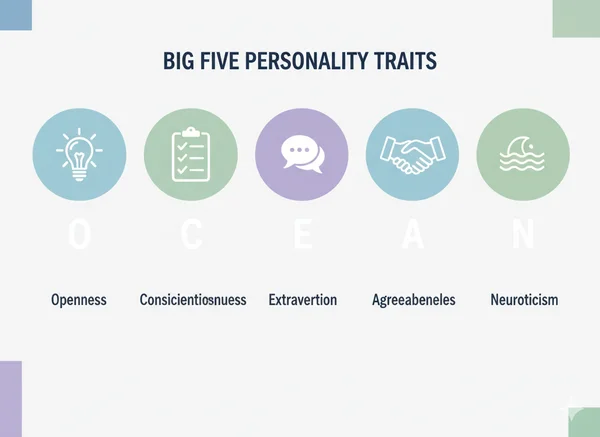
Openness – Curiosity, Creativity, and New Experiences
If you score high in openness, you likely enjoy trying new things, exploring creative ideas, and questioning the status quo. You may be drawn to art, travel, or philosophical conversations. On the other end of the spectrum, lower openness often shows up as a preference for routine, tradition, and practical thinking.
Self-reflection prompt: Do you feel energized by unfamiliar experiences, or do you prefer what you already know?
Conscientiousness – Organization, Discipline, and Follow-Through
Conscientiousness describes how organized, responsible, and goal-oriented you are. Highly conscientious people tend to plan ahead, meet deadlines, and pay attention to detail. Those who score lower may be more spontaneous and flexible — which can be a strength in fast-changing environments but a challenge when long-term planning matters.
Self-reflection prompt: When you start a project, do you create a plan first, or do you prefer to figure it out as you go?
Extraversion – Energy, Sociability, and Assertiveness
Extraversion measures how much energy you draw from social interaction. Extraverts tend to be talkative, enthusiastic, and comfortable in group settings. Introverts — those lower in extraversion — often prefer one-on-one conversations, quiet environments, and time alone to recharge. Neither end is better or worse; each comes with unique advantages.
Self-reflection prompt: After a long social event, do you feel energized or drained?
Agreeableness – Kindness, Cooperation, and Empathy
Agreeableness reflects how warm, cooperative, and considerate you tend to be. Highly agreeable people often prioritize harmony in relationships, show empathy easily, and go out of their way to help. Those lower in agreeableness may be more direct, competitive, or skeptical — traits that can serve them well in negotiation or critical analysis.
Self-reflection prompt: In a disagreement, is your first instinct to find common ground or to hold your position?
Neuroticism – Emotional Sensitivity and Stress Response
Neuroticism measures your tendency to experience negative emotions like anxiety, sadness, or irritability. A high score doesn't label you as "unstable." It simply means you may be more sensitive to stress and emotional ups and downs. People lower in neuroticism tend to stay calm under pressure and recover from setbacks more quickly.
Self-reflection prompt: When something goes wrong, do you tend to dwell on it, or do you move on fairly quickly?
Positive Personality Traits and What They Look Like
When people search for a personality traits list, they often want examples they can recognize in themselves or others. Positive personality traits are qualities that tend to benefit you and the people around you. Here are some of the most commonly valued ones.
Examples of Positive Traits in Relationships and Work
- Empathy — You can sense what others are feeling and respond with care
- Resilience — You bounce back from setbacks without losing direction
- Honesty — You communicate openly, even when it's uncomfortable
- Adaptability — You adjust smoothly when plans or circumstances change
- Patience — You stay calm and understanding in stressful situations
- Reliability — People count on you to follow through on commitments
- Curiosity — You ask questions and genuinely want to learn
- Generosity — You share your time, knowledge, and resources freely
- Optimism — You tend to focus on solutions rather than problems
- Courage — You take thoughtful action even when it feels risky
How Positive Traits Show Up Across the Big Five
Each of the Big Five dimensions connects to recognizable positive traits:
| Big Five Dimension | Associated Positive Traits |
|---|---|
| Openness | Creativity, curiosity, open-mindedness |
| Conscientiousness | Reliability, discipline, thoroughness |
| Extraversion | Enthusiasm, assertiveness, warmth |
| Agreeableness | Empathy, cooperation, generosity |
| Low Neuroticism | Calmness, emotional stability, resilience |
Keep in mind that positive personality traits are not fixed achievements. They exist on a spectrum, and everyone expresses them differently depending on context.
Common Negative Personality Traits – and How to Manage Them
Negative personality traits are patterns that can create friction in relationships, hold you back at work, or affect your well-being. Recognizing them is not about self-judgment — it's about gaining clarity so you can make intentional changes.

Negative Traits That May Affect Relationships
- Impatience — Rushing others or dismissing their pace
- Stubbornness — Refusing to consider alternative viewpoints
- Pessimism — Consistently focusing on what could go wrong
- Self-centeredness — Difficulty considering others' needs or feelings
- Hostility — Reacting with anger or aggression under stress
- Dishonesty — Bending the truth to avoid discomfort
When a Strength Becomes a Weakness – Context Matters
Here is something many personality trait guides leave out: a trait that serves you well in one situation can work against you in another. For example:
- High conscientiousness may become perfectionism that slows you down
- High agreeableness may make it hard to set boundaries
- Low neuroticism may cause you to overlook legitimate concerns
Context is everything. The same trait can be an asset or a challenge depending on the situation.
Practical Steps to Manage Challenging Traits
- Name the pattern — Identify which trait shows up most often in difficult situations
- Notice the trigger — Pay attention to what circumstances bring out the behavior
- Pause before reacting — Give yourself a moment to choose a response instead of defaulting to the pattern
- Ask for feedback — Trusted friends or colleagues can offer perspective you might miss
- Be patient with yourself — Personality change is gradual; small, consistent shifts add up over time
Personality Types vs. Personality Traits – Key Differences
You have probably seen personality types mentioned alongside personality traits, but they are not the same thing. Understanding the difference helps you choose the right framework for self-exploration.
Why Psychologists Prefer Traits Over Types
Type-based systems — like the Myers-Briggs Type Indicator (MBTI) — sort people into distinct categories. You are either an introvert or an extravert, a thinker or a feeler. However, most research psychologists favor trait-based models because they describe personality on a spectrum. You are not simply "an introvert." Instead, you score somewhere along the extraversion scale, which gives a more accurate and nuanced picture.
Big Five vs. MBTI – A Quick Comparison
| Feature | Big Five (OCEAN) | MBTI |
|---|---|---|
| Basis | Empirical research | Theory-based typology |
| Measurement | Spectrum/continuous | Categorical (16 types) |
| Scientific support | Strong and widely replicated | Mixed; debated reliability |
| Best for | Research, clinical, and workplace applications | Team-building and casual self-discovery |
| Output | Trait scores on 5 dimensions | A 4-letter type label |
Both frameworks can offer useful insights. However, if you want a scientifically grounded understanding of your personality traits, the Big Five model is the stronger starting point.
How Are Personality Traits Measured?
If you want to go beyond general descriptions, structured personality assessments can help you see where you fall on each trait dimension. These tools use carefully designed questionnaires to measure your tendencies across different scenarios.
Common Personality Assessment Tools
- Big Five Inventory (BFI) — A widely used questionnaire that measures each OCEAN dimension
- NEO Personality Inventory (NEO-PI-R) — A more detailed assessment used in research and clinical settings
- HEXACO Personality Inventory — Adds a sixth dimension (Honesty-Humility) to the Big Five
- Online self-report assessments — Many platforms offer free, science-based personality assessments for personal reflection
What to Expect From a Science-Based Personality Assessment
A good personality assessment will ask you to rate how strongly you agree or disagree with a series of statements about your behavior and preferences. Your responses generate a profile showing where you fall on each trait spectrum. Remember, these results are meant for self-understanding — they are not clinical diagnoses and should not replace professional evaluation if you have specific concerns.
Can Personality Traits Change Over Time?
One of the most common questions about personality traits is whether they can actually shift. The short answer: yes, but gradually.
What Research Says About Trait Stability
Studies in personality psychology suggest that the big five personality traits are relatively stable across adulthood — but not set in stone. Most people experience modest increases in agreeableness and conscientiousness as they age, while neuroticism tends to decrease. These shifts are slow and may not feel dramatic in the moment.
Factors That Shape Your Personality Across Life
Several forces can influence your personality traits over time:
- Major life events — Marriage, parenthood, career changes, or loss can shift how you respond to the world
- Intentional effort — Therapy, coaching, and deliberate practice can help you reshape patterns
- Cultural and social context — The environment you grow up in and live in plays a role
- Aging and maturity — Natural development often brings greater emotional stability and self-awareness
Change is possible, but it tends to happen through consistent small steps rather than overnight transformation.
Explore Your Own Personality Traits
Now that you understand the key frameworks and examples, you might be curious about your own trait profile. Self-reflection is a powerful next step — and it does not have to be complicated.
Why Self-Reflection Is the Next Step
Reading about personality traits is informative, but real insight comes when you turn the lens inward. Ask yourself how you typically respond to stress, conflict, novelty, and social situations. Journaling, mindful observation, and honest conversations with people you trust can all sharpen your self-awareness.
How a Free Personality Assessment Can Help You Grow
If you want a structured starting point, a free personality assessment from PsychologyTest.net can help you organize your reflections. Our science-based tools provide personalized insights into your unique trait profile — without pressure, judgment, or clinical claims. Think of it as a way to gather your thoughts and identify patterns you might not notice on your own.
This assessment is designed for self-understanding and personal growth. It is not a clinical diagnosis and should not replace professional evaluation.
Understanding Your Personality Is a Lifelong Journey
Personality traits are not labels that lock you into a box. They are dynamic patterns that give you a starting point for self-understanding. Whether you scored high in openness or lean toward quiet conscientiousness, every trait profile comes with strengths worth celebrating and areas worth exploring.
Here are the key takeaways from this guide:
- Personality traits describe stable patterns of thinking, feeling, and behaving
- The Big Five (OCEAN) model is the most scientifically supported framework
- Both positive and negative personality traits exist on a spectrum — context matters
- Trait-based models offer more nuance than type-based systems like MBTI
- Your personality traits can shift gradually over time with effort and experience
- Self-reflection and structured assessments can deepen your understanding
If you are ready to take the next step, explore personality insights at PsychologyTest.net — a free, anonymous, and science-based resource designed to support your journey of self-discovery.
If you are experiencing significant emotional distress or mental health concerns, please consider reaching out to a licensed mental health professional.

Frequently Asked Questions
Are personality traits genetic or learned?
Personality traits develop through a combination of genetic predisposition and environmental influence. Research suggests that roughly 40–60% of personality variation has a heritable component, while life experiences, culture, and personal choices shape the rest. Both nature and nurture work together to form your unique trait profile.
What personality traits make a good leader?
Effective leaders often score high in conscientiousness, extraversion, and emotional stability (low neuroticism). However, leadership styles vary widely, and traits like agreeableness, openness, and empathy also play important roles depending on the team and context.
How many personality traits are there?
There is no single definitive number. Psychologists have identified hundreds of specific traits, but the Big Five model groups them into five broad dimensions — openness, conscientiousness, extraversion, agreeableness, and neuroticism — to provide a manageable and research-backed framework.
Which personality traits are most important for teamwork?
Agreeableness, conscientiousness, and emotional stability tend to support effective teamwork. Agreeable team members foster collaboration, conscientious members stay on task, and emotionally stable individuals help keep group dynamics calm under pressure.
Can you have both positive and negative versions of the same trait?
Yes. Most personality traits exist on a spectrum, and the same trait can be helpful or harmful depending on the situation. For example, high agreeableness supports harmony but may make boundary-setting difficult. Context determines whether a trait works for or against you.
How do personality traits affect mental health?
Certain trait patterns may increase vulnerability to specific challenges. High neuroticism, for instance, is associated with greater sensitivity to stress and higher risk for anxiety or mood difficulties. However, personality traits are just one factor among many, and professional support is always available if you need it.