Personality Types Explained Across 4 Types, ABCD, MBTI, and Traits
Personality types are shorthand ways to describe recurring patterns in how people think, react, relate, decide, and manage energy. They can be useful when you want language for self-reflection, teamwork, relationships, or fictional character analysis, but they work best when they stay flexible. A type is not a fixed identity, a clinical label, or a complete map of a person. If you are using personality types to understand yourself, pair the label with real examples from daily life and a wider view of mood, stress, values, and context. For a broader mental well-being check-in, you can also explore a structured self-reflection tool that treats assessment as information for personal growth.
What Personality Types Are Meant to Do
Personality typing turns complex human patterns into simpler categories. That simplification is the point: it gives people a quick vocabulary for differences that might otherwise feel personal or confusing. For example, one person may feel energized by group brainstorming, while another thinks best after quiet processing. One person may want a firm plan, while another wants room to adapt. A type framework can make those differences easier to discuss without assuming that one style is better.
The risk is overreach. Human personality is shaped by temperament, learned habits, culture, stress level, maturity, roles, and current life conditions. Most people can recognize themselves in more than one type description. A good personality type test or quiz should invite reflection, not lock you into a box.
This is where personality types and personality traits differ. Types sort people into named categories. Traits describe dimensions that vary by degree, such as extraversion, agreeableness, conscientiousness, emotional reactivity, or openness to new experience. Types are easy to remember. Traits are often better for nuance. In practice, the most useful approach is to treat a type as a starting hypothesis and then ask, "Which traits, situations, and habits make this feel true for me?"
The 4 Personality Types and ABCD Personality Types
Searches for "4 personality types" can point to several different systems. The oldest popular version is the four temperaments: sanguine, choleric, melancholic, and phlegmatic. In modern everyday use, sanguine often means sociable and enthusiastic, choleric means assertive and goal-driven, melancholic means thoughtful and detail-aware, and phlegmatic means calm and steady. These labels are simple and memorable, but they are broad folk categories rather than a precise modern assessment model.
Another common four-part model is Type A, Type B, Type C, and Type D. Type A is usually associated with urgency, competitiveness, ambition, and impatience. Type B is often described as more relaxed, flexible, and less driven by time pressure. Type C is commonly framed as careful, controlled, detail-focused, and conflict-avoidant. Type D is often linked with distress-prone and socially inhibited patterns. These descriptions can help people notice stress and communication habits, but they should not be treated as permanent verdicts.
ABCD personality types are especially popular because they feel practical: four letters, four quick profiles, easy comparisons. Still, the better question is not "Which letter am I forever?" but "When do I act like this, and what does it cost or help?" A person may show Type A urgency at work, Type B flexibility with friends, Type C caution in unfamiliar settings, and Type D withdrawal during prolonged stress. That is not contradiction; it is context.
If you want to use ABCD types well, write down one real behavior for each label. Concrete examples keep the model grounded.
The 16 Personality Types and MBTI-Style Codes
The 16 personality types come from a four-letter code system often associated with Myers-Briggs-style personality typing. Each code combines one preference from four pairs: Extraversion or Introversion, Sensing or Intuition, Thinking or Feeling, and Judging or Perceiving. That creates familiar codes such as INTP, INFJ, ENFP, ESTJ, ISFP, or ENTJ.
These codes are popular because they compress several questions into one memorable label. Do you usually gain energy through outer interaction or inner reflection? Do you first trust concrete details or patterns and possibilities? Do you lean on impersonal logic or personal values when deciding? Do you prefer structure or open-ended flexibility? When people ask "What personality type am I?" they are often trying to answer those four questions in a personal way.
However, the 16-type model can become misleading when people treat each letter as an absolute switch. Introvert does not mean antisocial. Feeling does not mean irrational. Judging does not mean judgmental. Perceiving does not mean careless. A person can prefer one side and still use the other side often. The code is a pattern of tendencies, not a complete description of ability or character.
For searches such as "INTP personality type" or "ENFJ personality type," the best answer includes both strengths and watch-outs. An INTP may enjoy systems and independent analysis; an ENFJ may be skilled at reading group needs. Both still need habits, boundaries, and context. The type can point to reflection questions, not life instructions.
DISC, Traits, and Other Personality Type Lists
DISC personality types organize behavior around Dominance, Influence, Steadiness, and Conscientiousness. The model is often used in workplace communication because it focuses on visible behavior: directness, sociability, patience, precision, pace, and response to conflict. A DISC-style result can be useful when a team needs shared language for meetings, feedback, and decision-making.
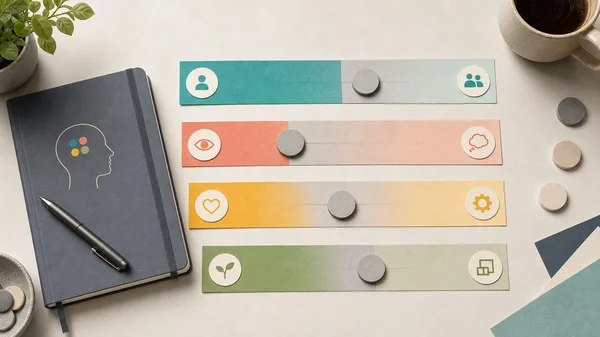
Trait-based systems take another path. Instead of saying "you are one type," they ask where you fall on several dimensions. Big Five-style trait models, for example, describe patterns such as openness, conscientiousness, extraversion, agreeableness, and emotional stability. If you have already read about personality traits, think of type systems as labels and trait systems as sliders. Labels are easier to remember; sliders are often easier to personalize.
There are also cultural and pop systems, including blood type personality beliefs, color personality tests, fictional character typing, and online quizzes that group people into archetypes. These can be fun for conversation, but they should be kept separate from evidence-informed self-assessment. A personality type can help you notice a pattern. It should not be used to limit your choices, dismiss someone's feelings, or explain away harmful behavior.
The most responsible use is comparative. If several systems point to the same theme, such as structure needs, social sensitivity, fast decisions, or conflict avoidance, that theme is worth exploring. If systems disagree, your behavior may change across settings, or the categories may be too broad. In either case, the broader psychology test framework can help you think about patterns as clues rather than fixed labels.
How to Find Your Personality Type Without Getting Boxed In
Start with the reason you want a type. Are you trying to understand your communication style, career preferences, stress habits, relationship patterns, or creative identity? A vague quiz result is less helpful than a focused question. "Why do I avoid conflict?" is more actionable than "What kind of person am I?"
Next, take any personality type quiz with a calm mindset. Answer based on your usual behavior, not your ideal self, your worst week, or how someone else wants you to be. If the format forces choices that feel too narrow, note that.
Then compare the result with evidence from your life. Look for three examples that fit and three examples that do not. If your result says you are introverted, when do you still seek stimulation and connection? If it says you are highly structured, when do you prefer improvisation? This step prevents the label from becoming a costume.
Finally, translate the result into one small experiment. A Type A pattern might pause before replying. A Type C pattern might share a draft earlier. An INTP pattern might schedule a concrete follow-up after a deep idea session. An ENFJ pattern might ask, "What do I need?" before coordinating everyone else's needs.

Personality Type Results and Mental Well-Being
Personality type content sits near psychology, but it is not the same as mental health care. A type may describe preferences, habits, or social patterns. It cannot decide whether you have a mental health condition, and it should not replace support from a qualified professional when you feel unsafe, overwhelmed, or unable to function in daily life.
This distinction matters because some traits overlap with stress responses. Someone who withdraws may call themselves introverted when they are exhausted. Someone who is tense and driven may call themselves Type A under chronic pressure. Labels can give language, but they do not explain everything.
Use personality types as one layer of self-knowledge. Add mood, sleep, relationships, workload, body signals, and recent life events. If your result brings relief, ask what it helps you understand. If it brings shame, fear, or a sense of being trapped, step back from the label. A useful assessment should make reflection clearer, not smaller.
Use Personality Types as a Starting Point
The best way to use personality types is to move from label to pattern, from pattern to choice, and from choice to practice. A four-letter code, ABCD profile, temperament label, or DISC style is valuable when it helps you communicate better, notice stress sooner, respect differences, or choose habits that fit real life.
Try a simple closing exercise: write your current type result at the top of a page, then make three columns: "What fits," "What does not fit," and "What I want to try." This keeps the type flexible and personal. It also protects you from using a category as a life sentence.
If you want a wider self-reflection path, pair personality typing with an anonymous personal growth check-in and treat the result as a conversation starter. Your personality type can be a useful mirror, but you are allowed to revise what you see as you gather more evidence about yourself.
FAQ
What are the 4 types of personality?
"The 4 types of personality" can refer to different systems. The four temperaments use sanguine, choleric, melancholic, and phlegmatic. ABCD typing uses Type A, Type B, Type C, and Type D. DISC uses Dominance, Influence, Steadiness, and Conscientiousness.
What are the 16 personality types?
The 16 personality types are four-letter codes built from four preference pairs: Extraversion or Introversion, Sensing or Intuition, Thinking or Feeling, and Judging or Perceiving. Examples include INTP, ENFJ, ISTJ, ESFP, and ENTJ.
What is Type A, B, C, D personality?
Type A is commonly linked with urgency and competitiveness. Type B is often relaxed and flexible. Type C is usually careful, controlled, and detail-focused. Type D is often associated with distress-prone and socially inhibited patterns. Use them for reflecting on habits and stress, not fixed identities.
Are personality types the same as personality traits?
No. Personality types group people into named categories, while traits describe dimensions that vary by degree. A type might say "INTP" or "Type A." A trait description might say someone is high in conscientiousness or moderately introverted. Traits often capture more nuance, while types are easier to discuss.
What are the 20 personality types?
There is no single standard list of 20 personality types. Some online searches mix the 16 Myers-Briggs-style types with four ABCD types or four temperament labels. That can be useful for comparison, but it is not one unified model. If a page lists 20 types, check how it defines each category.
Can a personality type test tell me exactly who I am?
No. A personality type test can offer language for patterns you may recognize, but it cannot capture your full history, culture, values, relationships, stress level, or future growth. Use results as prompts for reflection, and seek qualified support if emotional or behavioral concerns are affecting safety or daily functioning.