Understanding Implicit Bias: Definition, Examples, and How to Manage It
You probably consider yourself a fair and open-minded person. Most of us do. Yet decades of psychological research reveal that nearly everyone carries hidden preferences — automatic mental shortcuts that quietly shape how we judge, react, and decide. These hidden patterns are called implicit biases, and they influence behavior at work, in relationships, and in everyday interactions — often without any conscious awareness. If you have ever wondered what implicit bias really means, how it shows up in daily life, or what you can do about it, this guide is for you. Below, you will find clear definitions, relatable examples, a comparison with explicit bias, and practical strategies to start managing your own unconscious patterns. For a deeper look at the psychological forces behind your everyday decisions, explore free assessments at PsychologyTest.
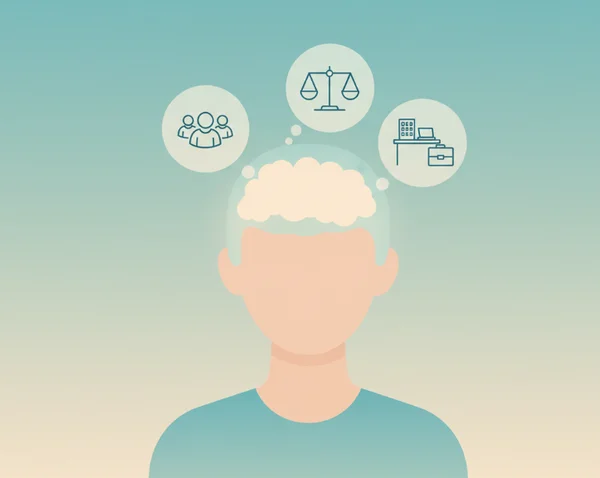
What Is Implicit Bias and Why Does It Matter?
Implicit bias refers to attitudes, stereotypes, or beliefs that influence your perceptions and actions at an unconscious level. Unlike opinions you deliberately hold, these biases operate automatically — often contradicting what you consciously believe.
How Psychologists Define Implicit Bias
In psychology, implicit bias describes learned associations that the brain forms over a lifetime of exposure to cultural messages, media portrayals, personal experiences, and social norms. Because these associations are stored in fast, automatic cognitive pathways, they can activate before your slower, deliberate reasoning has a chance to intervene.
The term gained widespread attention through the work of researchers Mahzarin Banaji and Anthony Greenwald, who developed the Implicit Association Test (IAT) in the late 1990s. Their research demonstrated that people frequently hold unconscious preferences that differ sharply from their stated values.
Why These Hidden Patterns Matter More Than You Think
Implicit bias matters because it affects real outcomes. When hiring managers, teachers, healthcare providers, or even friends make snap judgments, those judgments carry consequences — sometimes quietly reinforcing inequity across entire systems.
Consider these key points:
- Implicit biases are universal. Having them does not make you a bad person. It makes you human.
- They are learned, not hardwired. Anything learned can, with effort, be re-examined.
- They become problematic when they go unchecked and translate into unfair decisions.
Understanding that implicit bias exists is the essential first step toward managing it.
Common Examples of Implicit Bias in Everyday Life
The concept of implicit bias can feel abstract until you see it in action. Here are examples organized by the contexts where these biases tend to surface most.
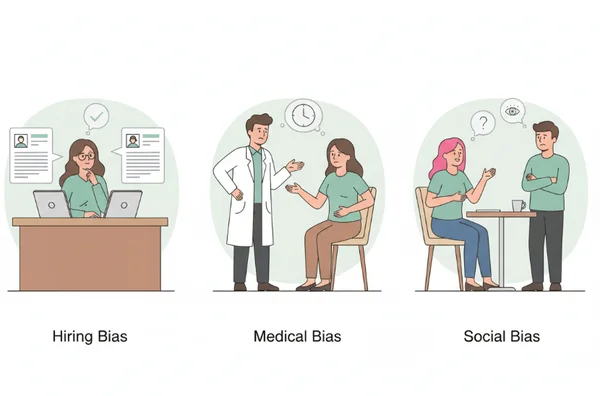
Implicit Bias in Hiring and the Workplace
Research consistently shows that identical resumes receive different callback rates depending on whether the applicant's name sounds traditionally white, Black, male, or female. A manager may genuinely believe they evaluate talent objectively — yet still gravitate toward candidates whose background mirrors their own.
Common workplace forms include:
- Affinity bias — favoring people who share your background, interests, or communication style.
- Halo effect — assuming someone who excels in one area must be competent in all areas.
- Confirmation bias — looking for evidence that supports an initial impression and ignoring evidence that contradicts it.
Implicit Bias in Healthcare and Education
In healthcare, studies show that implicit racial biases among providers can affect pain assessment, treatment recommendations, and referral rates. For example, research has found that some providers unconsciously underestimate the pain levels of Black patients compared to white patients with identical symptoms.
In education, teacher expectations shaped by implicit bias may influence discipline decisions, access to gifted programs, and even grading patterns — particularly affecting students from minority backgrounds.
Everyday Social Interactions You Might Not Notice
Implicit bias also appears in smaller, subtler moments:
- Crossing the street when someone of a particular appearance approaches.
- Assuming a person's competence based on their accent or clothing.
- Automatically attributing leadership qualities to taller or deeper-voiced individuals.
These micro-moments may seem minor in isolation. However, when they accumulate across an entire society, they create measurable disparities.
What Is the Difference Between Implicit and Explicit Bias?
One of the most frequently asked questions about implicit bias is how it compares to explicit bias. Although both involve prejudice, they operate through fundamentally different mechanisms.
Key Characteristics That Set Them Apart
| Feature | Implicit Bias | Explicit Bias |
|---|---|---|
| Awareness | Unconscious — you may not know it exists | Conscious — you are aware of the attitude |
| Control | Automatic and difficult to regulate | Deliberate and can be expressed or suppressed |
| Measurement | Requires indirect tools like the IAT | Can be measured through surveys or self-report |
| Alignment with values | Often contradicts your stated beliefs | Typically consistent with your stated beliefs |
| Social acceptability | May persist even when norms change | Often reduced by social pressure |
The critical distinction is this: a person can genuinely oppose discrimination at a conscious level while still carrying implicit associations that lean in the opposite direction.
Can You Hold Both at the Same Time?
Yes. In fact, research suggests this is extremely common. You might consciously support gender equality in the workplace yet unconsciously associate leadership more strongly with men. This internal disconnect is central to why implicit bias is so challenging — and why self-awareness matters so much.
How Implicit Bias Shapes Your Decisions Without You Knowing
Understanding what implicit bias is matters most when you see how it silently filters your choices.
Decisions You May Not Realize Are Influenced
Implicit bias shows up in situations where speed, ambiguity, or cognitive overload push the brain toward shortcuts:
- Hiring: Choosing between two equally qualified candidates and "going with your gut."
- Social settings: Deciding whom to sit next to, approach, or trust at a gathering.
- Conflict resolution: Interpreting the same behavior differently depending on who does it.
- Everyday assumptions: Expecting certain roles, talents, or limitations based on someone's appearance.
Because these decisions feel natural and intuitive, they rarely trigger self-examination.
The Ripple Effect on Relationships and Opportunities
When implicit bias shapes repeated decisions across many people in a system — employers, teachers, landlords, healthcare providers — the accumulated effect creates systemic patterns of advantage and disadvantage.
On a personal level, unchecked implicit bias can erode trust in friendships, romantic partnerships, and family dynamics. Someone who feels consistently misjudged may withdraw — even if neither party consciously recognizes the pattern.
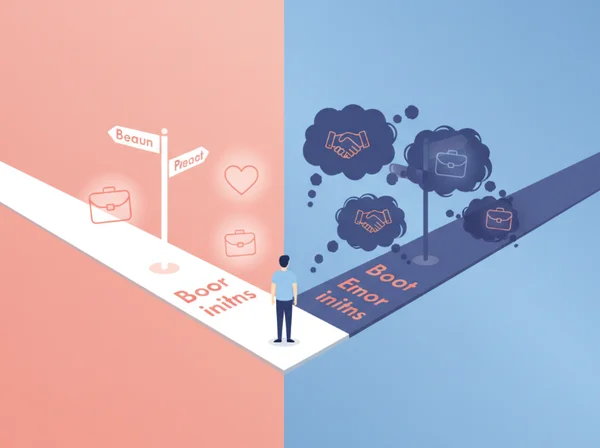
Practical Steps to Recognize and Reduce Your Implicit Bias
The good news is that implicit bias is not permanent. Because these associations are learned, they can be weakened and gradually replaced with more accurate, individualized thinking. Here are strategies supported by research.
Slow Down Your Snap Judgments
Many implicit biases gain power when you make fast, automatic evaluations. One of the simplest countermeasures is to deliberately pause before important decisions — especially those involving people.
Ask yourself:
- Am I making this judgment based on the individual's actual performance, or on assumptions about their group?
- Would I react the same way if this person looked, sounded, or came from a different background?
This brief pause interrupts the automatic pathway and gives your deliberate reasoning a chance to engage.
Seek Out Diverse Perspectives and Experiences
Research suggests that meaningful, positive contact with people from different backgrounds reduces the strength of implicit associations over time. This means:
- Actively broadening your social circle.
- Consuming media that features diverse voices and stories.
- Listening to perspectives that challenge your default viewpoint — with genuine curiosity.
Use Structured Decision-Making to Limit Bias
In professional settings, one of the most effective strategies is to remove opportunities for bias to operate. For example:
- Use standardized interview questions and scoring rubrics.
- Implement blind resume reviews that hide names and demographic details.
- Create clear evaluation criteria before reviewing candidates or performance.
Structure does not eliminate bias entirely, but it significantly narrows the space where unconscious associations can take hold.
A Quick Self-Reflection Checklist
Use this checklist as a starting point for noticing your own patterns. It is not a diagnostic tool — simply a prompt for honest self-observation.
- Do I tend to feel more comfortable around people who look or think like me?
- Have I ever assumed someone's competence based on their appearance or accent?
- Do I react differently to the same behavior depending on who performs it?
- When I picture a "leader," "scientist," or "nurse," does a specific demographic come to mind?
- Have I dismissed someone's perspective without fully hearing it because of an assumption?
If you checked even one box, that is perfectly normal. Awareness — not perfection — is the point.
How Self-Reflection Tools Help You Explore Hidden Patterns
Reading about implicit bias is valuable. Taking the next step to examine your own patterns makes the learning personal and actionable.
Why Self-Awareness Is the Logical Next Step
Knowledge alone does not change behavior. Research on bias reduction consistently shows that personalized feedback — seeing how your own responses align with broader patterns — is far more motivating than abstract information.
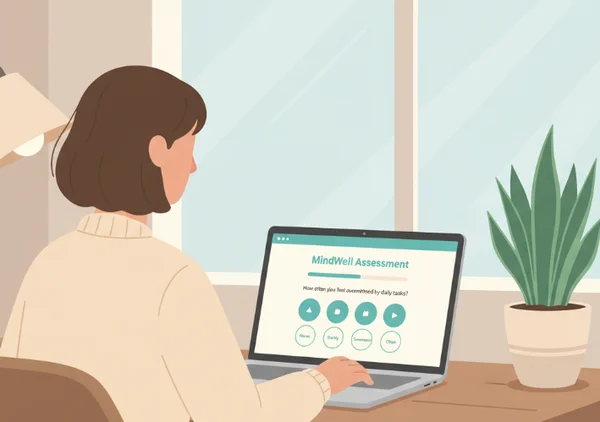
Self-reflection tools provide a structured, low-pressure way to explore your tendencies. They help you organize your thoughts, notice recurring patterns, and identify areas where you might want to grow.
Important: Self-reflection assessments are educational tools designed for personal insight. They do not diagnose, label, or judge you. They are a starting point for self-understanding — not a final verdict.
What You Can Explore With a Free Assessment
Platforms like PsychologyTest.net offer free, anonymous psychological assessments grounded in established research. These assessments can help you:
- Reflect on personality patterns and cognitive tendencies.
- Gain insight into how your experiences may shape your automatic responses.
- Identify areas for personal growth in a safe, private environment.
Think of it as a mirror — not a microscope. The goal is self-understanding, not self-criticism.
Moving Toward Greater Self-Awareness Every Day
Implicit bias is a normal part of how the human brain processes information. It does not define your character or values. What matters is what you do once you become aware of it.
Here are the key takeaways from this guide:
- Implicit bias is universal. Everyone carries unconscious associations shaped by life experience and culture.
- It differs from explicit bias because it operates automatically and often contradicts your conscious beliefs.
- It affects real outcomes in hiring, healthcare, education, relationships, and daily interactions.
- It can be managed through deliberate strategies: slowing down, seeking diverse perspectives, using structured decision-making, and practicing ongoing self-reflection.
- Self-awareness is a skill, not a destination. Small, consistent steps create meaningful change.
If this topic resonated with you and you want to take a deeper look at how your own thought patterns work, consider trying a free psychological self-assessment as a gentle next step.
This article is intended for educational purposes and personal reflection. It does not constitute professional psychological advice. If you are experiencing significant distress or need support for bias-related challenges, please consult a qualified mental health professional.
Frequently Asked Questions
Can implicit bias be changed or eliminated?
Implicit bias can be reduced over time through consistent effort, but most researchers agree it cannot be entirely eliminated. Strategies such as perspective-taking, counterstereotype exposure, and structured decision-making have been shown to weaken implicit associations. The goal is ongoing management rather than a one-time fix.
Why is implicit bias harmful even when unintentional?
Because implicit bias operates unconsciously, it can lead to unfair outcomes even when the person holds no conscious prejudice. Over time, these small, unintentional influences accumulate across systems — contributing to measurable disparities in areas like hiring, healthcare quality, and educational opportunity.
What is the Implicit Association Test and how does it work?
The Implicit Association Test (IAT) is a research tool developed at Harvard that measures the strength of automatic associations between concepts and evaluations. It works by tracking how quickly you pair certain groups with positive or negative attributes. Faster pairings suggest stronger unconscious associations.
Does implicit bias training actually work?
Evidence is mixed. Training programs tend to be effective at raising awareness, but single-session workshops rarely produce lasting behavior change on their own. The most effective approaches combine training with structural changes — such as blind hiring processes and accountability systems — and treat bias reduction as an ongoing organizational commitment.
How do implicit biases develop over time?
Implicit biases form through repeated exposure to cultural messages, media representations, family attitudes, and social environments throughout your life. The brain naturally categorizes information to process it efficiently, and these categories can absorb stereotypes and associations without your conscious input.
Are children already affected by implicit bias?
Yes. Research shows that children as young as three can exhibit implicit biases related to race, gender, and other social categories. These early biases are shaped by the cultural environment, family interactions, media exposure, and peer dynamics that children experience during their formative years.